Wednesday, August 5, 2009

Krakow Poland, July 30, 2009, Part II

Krakow, Part II, 29-30 July, Michael reporting...

One thing we were sure of in Krakow, it was that we were not on, nor were we interested in, nor do we ethically, morally, or florally support what this gentleman was advertising.


¡Viva Irregularity!

We also saw this small group of musicians, and a couple enjoying the music…


And then there was this… not only have we seen a rash of Michael Jackson biographies in bookstores throughout Europe, but even the puppeteers are getting into the spirit:


One notable event which we were happy to see was a long-standing Krakow tradition. Every hour, a trumpeter opens a window in the tower of the Basilica of the Virgin Mary and plays a melody, the same one since the Middle Ages. The trumpeter stops abruptly, to commemorate when a bugler was shot in the throat during the Mongol invasion of 1241. This same melody, by the way, was played on Radio Free Europe at the beginning of every broadcast.


After our meeting with Monica, we had a little time so headed to the south side of Krakow, to the old Jewish quarter. In a sadly familiar pattern, the Jews were kicked out of Krakow proper in the fifteenth century and forced to live in the Kazimierz section, a far less grand area. By the early twentieth century, however, Krakow had become a thriving center for Jewish cultural and spiritual life, where they were even given their own house of parliament. When the Nazis occupied Poland, they also forced the Jews out of the city and into a ghetto, this time on the other side of the river, but then of course most were sent to the worst of the death camps, which happen to be close to Krakow: Auschwitz and Birkenau. Oscar Schindler's factory is near the Nazi Jewish ghetto. Kazimierz, which now holds very few actual Jews, is now a quaint and fashionable area with comfortably dilapidated buildings, large leafy courtyards, and an obvious cashing-in on the Jewish past. We walked around, exploring the small streets, noting that many of the cafes and shops had Jewish names, displayed in huge letters on the storefronts. A few of the grand old synagogues still stand, where a tiny population of Jews still worship. We skirted the edge of the Jewish cemetery, but could not find a way past the high walls, so high we could not even see inside. Our problem was solved when Kevin cleverly spotted a bar/café bordering the cemetery that had a terrace section on the roof. We promptly went inside and up, planting ourselves at a table high above the street allowing us to see down fully into the cemetery. The tombstones were all inscribed in Hebrew, and many of them had metal “hats” that allowed visitors to deposit the customary rocks (out of respect, for you non-Jews out there) without damaging the tombstones. The graves were quite crowded together, particularly in some sections, reminding me a little of the Prague Jewish cemetery, where the bodies are stacked fourteen deep and tombstones crowd the hillocked earth so tightly that earth is barely visible. For some reason, though, in Krakow the area in the center of the cemetery is just a blank green hill… perhaps an area where the stones had been removed or destroyed (it is amazing the Nazis left anything standing here at all), but judging from the crowdedness of the rest, it is probably still an area with many souls.

Krakow Poland, July 30, 2009


Krakow Poland
Thursday, July 30, 2009

Kevin here.

Mike and I have seen a lot of beautiful town squares on this trip, but nothing compared with the majesty and elegance of Krakow’s central square. It was huge and colorful--and I’m pretty sure Mike will put up his traditional Cinema-360-Pan of it in the next blog. This city, so beautiful in every way, has an especially sophisticated and cool edge to it. The cafes where we rested, and sometimes wrote, were relaxed, shady, hip and chic. The lighting and lamps were often distinctive--indirect--and from unusual sources. In a number of bars and cafes there were hanging gourds, from which a thousand tiny holes had been drilled, and filled in with colored glass. Here’s a couple:


On Thursday the 30th we met Monika Wozniak in one of these ultra-relaxed urban bookstore cafes. Monika does academic work for the journal Przeklładaniec, which is dedicated to the academic discussion of translation. Her specialty is Italian-to-Polish translation and she is doing research currently on children’s literature. Monika confirmed for us some of the leading names in Polish literary nonsense and introduced us to a few new authors as well. She told us a few fascinating things about the connection between politics and nonsense in Polish literature. She described, for example, the communist attempt to introduce a new way of talking about ‘things’ in the 1950s. In what sounded like a very Orwellian plot, the Soviets required that writers in this era use, what the communists referred to as, “New Speak.” What exactly “New Speak” was, was difficult to describe. I asked Monika if “New Speak” was something like political correctness, or was possibly manifested by an Orwellian insistence on euphemisms. She said it was like those things, but that it was MORE than them too. According to Monika, New Wave Polish writers in the 1950s, such as Mrozék and Baranczek created what they described as a “new special language” and this new language rebelled directly against “New Speak,” and the result was often a rather sophisticated nonsense. In this Communist era, Monika explained, “Either you drink vodka, or you write nonsense.”

Monika also introduced us to the Polish nonsensical cabaret acts of Olga Lipinśka, which, in the 1970s, were also directed against communism. Lipinśka’s productions were carnivalesque, and reflected folk tradition, classics, New Speak, and slapstick. She noted that after the revolution of 1989, the nonsense featured in the cabarets lost its edge, because the oppressive government, and its oppressive language, was out of power.

I mentioned dragons before in this voyage, and I need to return to that subject briefly, because no visit to Krakow would be complete without mentioning Krak, the great flying lizard-beast that, tradition tells, lived in a cave beneath Wawel Castle in Krakow. If you go to the castle today you might notice the drainpipes, which are shaped like dragons: (click to enlarge)


From the castle’s edge there is also a mysterious entrance into what is known as, “The Dragon’s Den.” This spiral staircase leads down along the outer wall of one of the highest ramparts, and then disappears into the bowls of the rock below. Bravely following this dizzy staircase you are eventually emptied out into a surprisingly chilly and gloomy/roomy natural rock cave, far far below the castle. There is a creepy dungeon here, and more than enough room to park at least two mid-size dragons. Because there is a light at the end of this tunnel, you follow it, and eventually you break out into the open air under a small grove of trees nestled along the banks of the Vistula River. Then, just when you think you are now safe from dragons, there is the sound of a flame thrower, and you look up to notice that, yes, in fact there is a statue of Krak here, and yes, the statue is shooting great balls of orange flames out of its mouth. The maw of the dragon bursts forth flames for about five seconds, once every couple minutes. Quite remarkable. Remind me not to climb on this statue. Here is a picture of it:


Although it was tricky, Michael managed to catch a quick movie of the statue actually breathing fire:


Kevin

Monday, August 3, 2009

Wroclaw Poland (Part II)

Wroclaw Poland
Sunday, July 26 to Wednesday, July 29 2009

Of all the countries we have visited so far on this trip Poland promised to yield the most overwhelming crop of literary nonsense. Unlike other countries we have visited, where we met one or two scholars, we already had three appointments scheduled in Poland when we crossed the border--and three more introductions on top of that by the time we would leave. Poland would bring us much good stuff.

I’ve always harbored a special reverence and respect for Poland, and a deep regret that the U.S. and other allies in World War II left Poland to the Soviets after the Polish had fought alongside the allies throughout the entire war. My wife’s grandfather, Wladeslaw Iwanowski, was killed at Monte Casino, fighting the Nazis in one of the last battles of World War II. And then his country was given away to the Soviets.

So while I have a soft spot for Poland, and while Poland promised to offer us more nonsense than we could handle I must yet report one mind-numbing incident in Wroclaw. Poland ostensibly left communism, and its inherent inefficiencies, behind twenty years ago. Poland is a modern nation, the most prosperous and advanced of the countries we visited in Eastern Europe. But all this progress seems to have missed one official office--The Post Office. By the time we arrived in Poland we had been collecting nonsense for more than two weeks now. We had simply no more room for the nonsense we were collecting so we decided to mail a box home. When we told Majka that we had to mail a box from the Post Office her brow furrowed, and she murmured, “The line can be long there.”

I should note that in this post office there is only one window (and one person) that handles packages, and every citizen in Wroclaw who has a package to be mailed must go to that one window and see that one lady, whom I shall from here-forward refer to as The Post Office Marm. We got in this line with our two boxes all packed and when we got to the window we were handed two forms, printed helpfully in Polish and French, and we were whisked away. I’ve got some French, so after a while we managed to fill in the forms. By this time the line had grown, and we had no choice but to get in again, at the back. The line moved more slowly now. When we finally got up to the front the Post Office Marm looked at our forms and noticed that we had used return addresses from the United States--because that’s where we live. “Nie Nie Nie,” we were scoffed at. It was made to clear to us then that we must have a Polish address in order to mail the box. “But we don’t live here,” we exclaimed. Then she pointed at the form and said “Hotel.” And she took our original forms and threw those away and gave us new ones and sent us away.

A short while later we had refilled in the forms so that it looked like we lived at our hotel in Wroclaw. We stood up to get back in line and at that moment a woman appeared in line before us, scooting in with her little cart. Fine, she can go first. Well, it turns out this woman had twenty-eight small packages. And then came the real surprise. Much to our horror we watched as the Post Office Marm began to process the first of these twenty-eight small packages... and it is a sad tale. Fifteen minutes later this first of the twenty-eight packages had been processed. And then the Post Office Marm reached up and took the second package and started in on that one. And yes, fifteen minutes later the third... etc.

By the end of this ordeal we had spent about three hours in the Post Office mailing our two boxes. Feeling emotionally numb, and as Michael put it, “flattened,” we removed ourselves to a pub.

Below are a couple pictures of some of the books we mailed back to the States:


Kevin

Friday, July 31, 2009

Monday, 27 July, Wroclaw, Poland

Wroclaw, Poland
Monday, 27 July

We arrived in Poland with some anticipation: for Kevin, he is in the land of his wife’s ancestors; for me, the ancestral land of most of my family before the wars. It is strange to “come back” to a place with such a mixed and difficult history, a country that never gave up the struggle against the Nazis and yet a place where some of the worst atrocities occurred. I feel little connection to this country, though, probably because my grandparents never considered themselves Polish; their identity was strictly Jewish, an attitude common where the Jews were forcibly separated, going back to the middle ages. Despite the anti-Semitism and wartime atrocities, though, my Bubby used to speak positively of her childhood in Bialystok, the youth meetings they had in the forest, and the Polish friends who hid her and her family from the pogroms. When I look into the faces of the old people here, the ones who may have lived through that time, I think of such complexities of history and humanity.

We arrived in the evening and found ourselves comfortably ensconced at the HP Park Plaza Hotel, with casino attached, a lovely place overlooking the river, with its little bridges and islands, and the spires and squares of the old town across the water. In the morning, we met with Marek Oziewicz, who kindly brought with him Majka Tarnogórska, a philologist and expert, of all the most unlikely and ombliferous of things, on Polish literary nonsense for adults. She is currently working on a book about Polish limericks, but her initiation into the Grand Art happened three years ago, when she decided to dedicate her life to scholarship in nonsense. After picking up our collective jaws from the floor, Kevin and I listened intently as Marek and Majka sifted through the nonsense scene of Poland and Wroclaw (pronounced “Vrots-wov,” of course). Majka provided a comprehensive bibliography of many kinds of Polish nonsense, including some of the most exalted Polish poets who also, by no accident, were nonsense writers, including Barańczak, Tuwim, Gałczyński, and Słonimski. We learned that the political situation in Poland, a country that has been under one occupation or another for hundreds of years, necessitated the development of nonsense art, a kind of subversion that is almost impossible to confront or quell. We also learned of the “Orange Alternative” a movement of dwarves against Communism. Yes, that’s right, because people were not allowed to congregate for any kind of organized political activity, members of this group dressed as dwarves, held dwarf meetings and dwarf protests, advocating dwarf rights and the freedom of universal dwarfdom. It was not uncommon in the late 1980s for these dwarves to be seen, pointed hats flopping in the breeze, as they ran away from the police. Today, as one walks the cobbled streets of Wroclaw, the dwarves appear everywhere, as little statues on top of mailboxes, hiding on window ledges, simultaneously pushing and pulling a large metal globe. Here are two particularly disreputable dwarves :


Here, one of the dwarves participates in graffiti subversion.


It is a city steeped in a carnivalesque tradition of nonsense resistance.

One of the new aspects of nonsense that Majka introduced us to was the Polish proliferation of new nonsense genres. That is, many Polish writers were not only creating nonsense, but also inventing new sub-genres. For example, the “Gulliver limerick” is a limerick that deals with only a very small point. She said that once these genres of nonsense were created, other writers of nonsense took them up and wrote within them. Edward Lear, with his nonsense alphabets, recipes, ballads, botany, and limericks, was perhaps the greatest English example of such creation of nonsense types, but it has been extremely rare since then.

After lunch, we went with Majka to several local bookstores, where she helped us buy some of the most important Polish texts. Bookstore browsing is an exhausting and throat-parching activity, so we tipped our elbows at perhaps the oldest restaurant in Europe, in the town square. She was then extremely kind enough to invite us back to her apartment, to see her nonsense library and continue the elbow-tipping on what we were promised was her nonsensical balcony. We walked about 25 minutes, stopping at some shops to pick up food and beer, and landed at her lovely, airy apartment overlooking a courtyard filled with flowers and a small river nearby. We spent the rest of the evening, and into the night, going through her library, talking nonsense in its most sublime and lugumbrious aspects, and writing the following pieces “exquisite corpse”-style, each of us writing alternative lines.


Balcony Types

With sparrows and umbrellas down,
You will attack the nasty town.
They may defend with crows and crabs.
And now, my guys, we stop surprised
At all the weapons n’er surmised:
The blunder-boost! The flinging pies!
The screaming wasps and sacri-flies
Of first-born frogs, flung in abandon
“Be careful, guys, of what you stand in.”
Fastidious maid lies in the sun,
The maid makes lace for battles to come.
With sparrows and umbrellas down,
We stay in the walking gown,
We pace, we splay, we join the fray,
We justify the First of May.

and the following limerick:

There was an old man of Niger
Who encountered a nine-legged spidger.
He told it a story
About an Aunt in the lorry
That loquacious old man of Niger.

Majka is a true kindred nonsense spirit, and our connection will surely continue into the mists of the fuliginous and misty-fisty future.


PS. I wonder if nonsense poetry written by a Pole, a person of Polish ancestry, and a man married to a Pole can be included in the Polish section of the anthology…? Vote on it in the survey, in the left-hand panel!

Thursday, July 30, 2009

Prague, July 25-26, 2009, Part II

Prague, Czech Republic, Part II
26 July, 2009

Kevin has given the bulk of our fortuitous Prague adventures, but I wanted to add a few nibs, nabs, and slabs.

First, a prime scenic sweep of the main square in Prague, with a rare sighting of an Officer in Good (and sometimes Wobbly) Standing of the Ministry of Silly Walks.


Next, a bit of nonsense graffiti. A "fourier transform" of a cat?? Remember, click on photos to enlarge them...


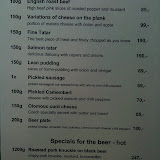
Lastly, a menu that was just too good not to capture in its entirely. Click here for the series of shots, and be sure to read closely. Be on the lookout for the Beer Plate (including “drowned man”), “Heel to be,” “Duck Season” (Wabbit season?), and other gems.
Prague Menu 7/25/09


Extra-double lastly, something oddly familiar, found in our last Prague hangout...

Prague, July 25-26, 2009


Prague, Czech Republic
Saturday/Sunday, July 25-26, 2009

Greeting Earthlings,

Kevin here.

When we were planning this trip I kept assuming that we would find an expert in Czech children’s lit in Prague. In the end we did not, but the information Nadezda Sieglova gave us about nonsense in Czech was fresh on our minds, and so as we entered the old capital we immediately ducked into a few bookshops hoping to find a few old classics in the genre. But the publishing situation we found in Brno was the same in Prague. In both places there were only new works available—no reprints of older classics of children’s lit. Truthfully I don’t think we know enough yet to really make the claim that there is a problem in republishing older material in Czech, but we did bat zero trying to find any reprints of several of the best regarded works of nonsense published in the 1960s.

This is not to say, however, that we weren’t lucky in Prague. Indeed, we were. Somewhere, as we ambled through the medieval maze that is Old Town Prague, I stopped Michael and showed him a listing in my guidebook that talked about an unusual theatre production company. The Divaldo Fantiska (or Black Light Theatre) is the brainchild of Jiri Srnec, who uses a variety of special effects, such as black lights, puppetry and shadows in his productions. I just thought it sounded interesting. Several aimless turns left and right later found us completely by accident staring at the outside of this very theatre. And what was playing there? “Aspects of Alice,” a production that uses Lewis Carroll’s Alice in Wonderland as a jumping off point for an exploration of coming-of-age stories and, simultaneously, the history of Prague. Kind of a wild idea really. As we looked at the poster that advertised the show we learned one other thing. The next show started in ten minutes. No, they did not take credit cards, but after a few minutes we’d found an ATM and were sitting in our seats, just two minutes before the curtain raised.


Although the story was intentionally a bit surreal, one did yet get the impression that the narrative was intended to be more clear. As a professor of nonsense I consider these things with care. Is it just sloppy, or is there an intentional, skillful, push and pull from reality at work in the writing? Czech art and literature is known for its commitment to surrealism, so our hopes were high for this production. In the end, however, I don’t think the play was intentionally very surreal, and I can safely say that there was not much nonsense at all. The connection to Lewis Carroll and his characters/stories was very slight. The visuals were stunning, however, from the black lit images of Prague steeples swimming through the night sky, to the creative use of playful candle flames that seemed to have minds of their own. It really was a memorable thing to watch and if they hadn’t warned us not to in four languages we probably would shot a clip for the blog.

That play will linger in my mind for some while, but, truthfully, like most tourists of Prague, it was the Old Town area that left the deepest impression. As others may have told you, or as you may have seen in your own travels, Prague’s Old Town is just simply beautiful and impressive. At one point we climbed the tower that looks over the Charles Bridge. We took a few photos from there of the Charles Bridge and of Old Town. At the top of the tower there is graffiti on the wall that dates back at least a couple hundred years. I read one carving that was clearly dated 1830. This apparently immortal version of ‘tagging’ immediately brings the present into the past and the past into the present. This graffiti feels strangely modern. As with nonsense, the reader of such a tag is pushed into a continuum, if not an indeterminate space and time. For just like graffiti today--whether it be under a bridge, or on building by a railroad track—such tagging is inspired by the need to leave behind a silent mark that proves you were there, a mark that stays there, and lives there long after you’ve left there. The ritual seems to suggest that existing in our own time and space is simply not enough.


Kevin

Tuesday, July 28, 2009

Brno, Czech Republic (Part II); July 24-25


July 24-25, 2009, Brno, Czech Republic


After our meeting with Dr. Nadezda Sieglova (described by Kevin below) we went on another hunt for nonsense within what we were told was a fairly crazy and humorous Czech folksong tradition. Two independent sources from Brno (which, by the way, is pronounced “Burr-no”), sent us to the folk museum in the center of town, where we struggled to communicate with a woman who was trying very hard to help us—in German and Czech. My handy iPhone translator (who dares scoff at its necessity??) gave us a few key words, and she contacted a researcher/worker somewhere in the building, who was very busy but came down to talk to us. Apparently, they didn’t have folk music there (curses to our sources!)—but she gave us an address for the Ethnology Institute a little outside of town. Another cab ride brought us to the doorstep, and we once again were faced with someone trying to help us, but with no English. She was able to find someone in the building to help us, and a few minutes later, a man in his 50s, looking like he just came in from gardening, came barreling down the stairs to meet us, large dirty beaker containing some mysterious clear liquid, in hand. He promptly informed us that we were in the branch of the Institute that dealt with chemistry, and the chances of finding folk music there were slim. However, beaker sloshing, he gleefully led us outside, down a path or two, to another building. Kevin’s curiosity got the better of him, and he had to ask what was in the beaker. Water, of course. He was thirsty. We soon approached a locked door with a panel of buttons. He pressed one, spoke briefly with the woman who answered, and got us buzzed into the building. We all walked up to an office where our friendly beaker man introduced us to Dr. Jana Pospisilova. We struggled with language, but she seemed quite interested in our project, and it quickly became apparent why: we seemed to have found, after two false leads, two inappropriate institutions, and one chemist, a real-live Czech scholar of children’s folk culture. She began to pull books down from her shelves full of folk songs and rhymes, many which we couldn’t read of course, but also some English translations from Finnish that were excellent. We all sat down and talked, as well as we could, about our work, about folk culture, and our great luck at having come together.

Kevin and I left delighted, with quite a few references to pursue in Czech and other languages. On our walk back to the city, we passed by this establishment, which I present here for your perusal.


We celebrated back in the town center, with a couple of pivos and a lovely view of the square.


I shall leave you with two more nonsensical nuggets of the day: a little graffiti as we wandered in Roma neighborhoods looking for a Laundromat.


And lastly, a menu, the last item of which we were not quite brave enough to order.