A True and Accurate Account of the Peregrinations and Polyanderings concerned with World Nonsense, including Travels into several Remote Nations of the World including the Lands of Snod, the Mysterious Mustache Island, and the Chankly Bore, about which shall be appended the Exploits and Opinions of Certain Members of the Society For the Prevention of Sense.
I interrupt the flow of time once again to let you know about my plans from here on out, and I do mean out. I will remain in Rättvik, Sweden until the 28th, when I head down to Malmö once again, this time to give a lecture at the university on the 29th, all thanks, once again, to Björn Sundmark. Check out this link for the sexy billing. On October 1st, I fly from Malmö to Stockholm, Stockholm to... Philadelphia (!) and then to Boston, where I shall set up a lingonberry shop on Newbury Street. It's hard to believe that this phase of the research trip is coming to a close...
My work in Helsinki for the moment complete, I was able to explore more today. In the morning, I got a call from Sirke Happonen who asked me, in the quickest possible manner so as not to incur the outrageous AT&T international roaming phone tariffs, “Culture Island or Nature Island?” I did not have to think long, and as I have long been an enemy of culture, I opted for “nature island.” On my walk south, I happened across this car near my accommodation, a most unlikely near-replica of my 1976 sky-blue (but black, here) Plymouth Valiant, that I had adopted from my Zeide.
Taking that as a good omen, I headed to Sirke's side of town, probably walking right past Tove Jansson’s home of many years. As I was to learn from Sirke, who is one of the most impressive Jansson scholars, Helsinki was always home to Tove and her family, even though she often traveled abroad. She grew up in the Katajanokka neighborhood, an island that now has some docks of the major cruise lines, and lived thereafter nearby, not far from where Sirke lives now. For those who don’t know, by the way, Tove Jansson (1914-2001) is best known as the author and illustrator of the acclaimed Moomin books, originally written in Swedish (she was a Swedish-speaking Finn), though she wrote many other books and considered herself an artist as much as a writer.
Before continuing, I should probably explain my connection to Tove Jansson more clearly. When I was in about the fourth grade, I had read little else besides Dr. Seuss. During our 2-hour “free” period (yes, at Stedwick, my groovy 70s elementary school, we had these stretches of time on our own, in addition to not having walls), I would often go to the library and plant myself in the Seuss section. One day, after having seen me in the same Seuss spot, perhaps for years, Mrs. Dinsmore the Librarian asked if I might want to read anything besides Dr. Seuss. I happily said no thank you (and I sometimes wish that I had carried through on that impulse thereafter), but she convinced me that she had something I would like. She dislodged me and brought me to a different section, from which she withdrew Tove Jansson’s Tales from Moominvalley. I was skeptical, but I dutifully sat down and read this book—and was immediately bewitched. The Moomins and their fellow creatures were unlike anything I had ever seen (and have since seen, by the way)—they seemed merely cute from the illustrations, yet I found them to be strange, almost uncanny. Soon thereafter, I fell into all the books, and reveled in the free-spirited, rebellious, thoughtful, wicked, independent-minded inhabitants of Moominvalley. Now that I am a children’s literature scholar (cough cough), I find these books even more fascinating, and I teach them almost every semester, always discovering, along with my students, a freshness about them. Mika Pohjola once told me that Moomin was his religion, and I can think of no more fitting way of conceptualizing these works. Of course, Tove Jansson wrote other books, some for adults, and while I have not read everything, I find each to place one more mossy stone, one more creeping shrub in her philosophical landscape.
The Moomins and Tove Jansson would be constant motifs in the next two days, something I might have expected from spending time with Sirke. At her apartment, I found distinct Moomin evidence, including, notably, her detailed framed print of the Moomin house blueprints, not to mention an impressive collection of Jansson books. Soon, Sirke, Ilmari (her son), and I were off to catch the ferry to Pihlajasaari, which we did with no time to spare. It’s a small ferry and only about a 15 minute ride to Pihlajasaari, one of the many islands that are just the beginning of the Helsinki archipelago. This one is relatively close to the city and yet, once we had landed, felt isolated and wild. The island is named after the trees that grow thick clusters of red berries, trees that had been worshipped before Christianity descended upon this part of the world. The island itself is mostly pristine, a landscape of moss and lichen-covered rocks and blasted, wind-blown trees.
Near the dock are these brightly colored sheds, a scene drawn by Jansson, as she no doubt visited this island many times.
As we walked to Sirke’s secret places, I had a strange sensation of familiarity, and a somewhat deceptive one, I might add. I had read so much Jansson, absorbed her epic illustrations and, perhaps, the overall feel of the Finnish coastal landscape, that it seemed, impossibly, I was in a familiar place. It attests, I think, to the vividness of her portrayal, both literary and pictorial, but to me it was another uncanny experience, a kind of artistic déjà vu. I couldn’t help but look in the bushes for Creeps, to listen for Snufkin’s plaintive tunes, or to scan the sea for the hattifatteners’ tossed sailboats, drifting to dark, thundercloud-covered islands. Sirke showed me one of her secret rock alcoves, where she has spent many a summer day reading and writing.
We went swimming in the cold, cold Gulf of Finland—quite a shock at first but then I didn’t want to get out. Later, Sirke found and gave me this:
To those who know the Moomins, this curled piece of birch bark has great significance, for it is these which the hattifatteners seek as they sail from rock to rock. When Moominpappa travels with them on one adventure, he summons the courage to examine one. He uncurls the scroll-like bark, expecting there to be some message: it is only blank bark, but in its unfurling, it discharges a slight electric shock. These charged, empty bark scrolls are a kind of mysterious communication, a hattifattener life-force currency that only increases their mystery. Along the paths, by the sauna (for there had to be a sauna) we walked and finally to the one commercial establishment, a restaurant/café with tables set out on a jutting rock shelf, looking out to sea.
We walked a bit more around and finally boarded the ferry to Helsinki. In a roundabout way home, we passed an area dedicated to the washing of carpets in the sea.
This is notable mostly because it brings up another Moomin moment—this time the ever-fretful Fillyjonk dragging her carpets to the shore for their regular cleaning. For her, it is the beginning of a day of doilies, tea, and awkward polite conversation, that would soon turn to purposeful, destructive storms and waterspouts that leave her homeless and happy in the most un-Fillyjonkish manner. This is not unlike how I felt after the white stone day.
ps. Read Tales from Moominvalley, and you’ll understand all these references!
pps. The next day I met Sirke again before leaving on the Viking cruise to Stockholm, and then on to Rättvik. In the central park in Helsinki, she showed me this statue, created by Tove Jansson's father, Viktor, who often used his family as models.
A café, the University of Helsinki, and beyond This morning I had an appointment to meet one of those rare creatures: a fellow dedicated scholar of nonsense. When I started this trip, I didn’t realize just how many of us there were (look back through the blog in astonishment at our forces, growing daily in number!), and even though our collective mass would not fill the head of a pin, there is some comfort knowing that we are not alone tilting against the windgills (from which the obscure amphibious plum pudding flea breathes, alternately). About a block from my university accommodation at the coffee shop Entré, I met Sakari Katajamäki, an editor at the Finnish Literature Society and, as I was to find out, not only an expert in nonsense literature, but also a musician, teaching musicians how to read literature (of all the absurd things). If he had only had a mysterious mustache, I would have embraced him like a brother, but as things stood, I shook his hand warmly as we recited the secret Nonsense Semi-Fictitious Felicitations, known to only those who detract this dark art. Sakari has published several articles on nonsense, including something in the brand new Nonsense and Other Senses: Regulated Absurdity in Literature, a volume resulting from a nonsense conference at the University of Warwick in 2006 which, somehow, Kevin and I missed, dagnabbit. I haven’t been able to read the volume yet, but it is very international-minded and sure to be a significant addition to nonsense scholarship. Sakari has worked extensively on Lauri Viita and other figures, and we had a fantastic nonsense conversation for a couple of hours, until he had to go to another appointment. He has offered his continued services for the Anthology, for which he shall find, forever henceforwardly, a hallowed place in the Nostalgic Nether Regions of Nonsense Numenescence.
After the meeting with Sakari, I met up again with Kaisu Rättyä, and after lunch, we went to a different library, one that specializes in books only from Scandinavian countries, where we looked at some more possible material. Kaisu knows Finnish children’s literature inside and out, after having directed the Finnish Institute for Children’s Literature in Tampere for many years, and she was able over these two days to go deep into the many nonsense possibilities of Finland. She also was kind enough to show me around the city a little and make me feel at home in Helsinki. From Scotland to Canada to Finland ten years later, and here we are.
Sadly, I parted company with Björn in Malmö and flew from Copenhagen to Helsinki, Finland.For many years I had been anticipating a visit to Finland, whether because of my deep connection to Tove Jansson from childhood (up to the present, teaching her in my Multicultural Children’s Lit. class at Berklee), the Finnish friends I met in 1999 at ChLA/IRSCL in Calgary (whom I would meet again, on this trip), or my newest Finnish friend, Mika Pohjola the talented musician and composer of Moomin music who has been kind enough to visit my classes in recent years.The lecture at the University of Helsinki was facilitated by Liisa Taino, the head of the department, but was initially set up by Sirke Happonen, with the help of Kaisu Rättyä, the latter two, as I mentioned, I met in 1999.We bonded back then when we all decided that, rather than go shopping during our brief outing in Banff, we would go for a swim in a glacial lake (little did I know at the time the fanatical swimming proclivities of the Swedes and Finns).The fateful party included Sirke, Kaisu, Björn, Sumanyu, and myself.We all got into a cab and asked to be taken to a lake, but the driver thought us crazy—he asked where our bathing suits were, our towels.We had nothing, and he just shook his head, dropped us off, and agreed to come back in a little while to return us to the city.After I averted an international incident by stopping my Scandinavian friends from striping down to nothing, we took a dip in our skivvies.The lake was cold.Cold.COLD. We survived, however, and the cab returned, but not empty. Our driver had gone to his home and loaded the cab with towels for us!Needless to say, we were bowled over by his kindness…
Little did I know that ten years later I’d have further professional (not to mention ablutionary) dealings with these fine Scandinavians.And so I found myself in Helsinki, with old friends, giving a lecture to a group of enthusiastic scholars who received me graciously.Afterwards, I was treated to a tea, where we proceeded to fill ourselves with Finnish treats and continued discussions of nonsense.One particular treat was the attendance of Jyri Komulainen, a lecturer in religion and an expert on Indian spirituality.Considering that a fair part of my talk deals with the spiritual aspect of nonsense in India, his input was most welcome.After tea, I went to a library with Kaisu and a new nonsense contact, Marja Suojala, who was also most helpful.We went through many books, talked even more about definitions and boundaries of the Anthology, and made selections and photocopies. Finland, of course, is full of nonsense, and some of the figures who might make it into the book are Kirsi Kunnas, Ilpo Tiihonen, Jukka Itkonen, Laura Ruohonen, Reetta Niemelä, and Mari Mörö.After so much of muchness, I went back to my university accommodations, noting the day to be a jab with a pointed stick in the eye of Sense!
I am writing one blog entry for my time spent in Malmö, Sweden, wherein I will combine a few things of note. There is little nonsense here, so if you are only here for the nonsense thrills, you might skip onward to Helsinki. Malmö had been my base of operations, of sorts, for around ten days. Björn was kind enough to set me up in the residence of the World Maritime University, an institution that, as you might imagine, trains people from around the world in maritime skills, from the business of international waters to the captaining of vessels. The students are all older, having worked in the maritime field in some capacity for quite a while. Governments from around the world send their most promising representatives, so the student body is by its nature entirely international and diverse. I chatted a bit with some of the boys on my hall, one from China and one from Bangladesh (whom I was able to greet in Bengali, to his amazement!), though I imagine our vastly different world made small talk a little strained.
During my time in Malmö, I was able to relax a little and become a resident, in a minimal way, having to shop and cook for myself, which, frankly was a relief after so much rich restaurant food. Of course, it just so happened that while I was there, the Malmö festival was happening, a huge street fair that went on night after night, and a place that I often went to sample some of the foods and bands. The food tended to be middling at best, but far better than the Swedish rap groups that populated one of the stages. Holy moly. I wish I had a film clip of some of those… I found the following food stall a cultural curiosity: it claimed to be a New Orleans-style foodery, and yet, as you can see from the extensive menu of burgerburgersteak&cheese, it was highly suspect.
Americans (non-natives, that is) may not have a culture that goes back thousands of years, but to shortchange one of our most culturally and culinarily interesting areas, New Orleans, makes me want to howl into my gumbo while gnashing my teeth against a shrimp po-boy, and wring my hands inside some crawfish etouffe.
Through the kindness of Carmen Browne, the friendly residence manager, I was able to borrow a bike and ride hitherwards and thitherdorf across the city and back. It was great to be back on a bike after so long, and even though my tires were mostly flat and I had those crazy backward-pedal brakes, I managed well enough. Here, I rode out to the most remote, rockiest, and skinniest strip of boulders I could find, on which there was a mini-lighthouse, a view of two nudities: the local nudist beach and the “Turning Torso,” a new architectural wonder in central Malmö.
In the water nearby, I found one of the most nonsensical of all flora, I mean fauna, I mean living goop, I mean seaslubberdegullion--the jellyfish. These had some exciting rings of colors...
I also found some interesting graffiti, and the culprits caught in the act:
One of the highlights of my time in Malmö was an excursion to Genarp, to visit Björn and his family. We had a lovely tea, and then Björn and I went for a walk through the Skäne countryside, looking for mushrooms along the way and, towards the end, taking a quick dip in a lake. Back at the house, I was treated to a rare and infamous tradition—that of eating surströmming, or sour herring. Surströmming is a kind of fermented herring that is so potently odiferous that it is rarely eaten indoors, and, so the urban legends go, has been the source of some stubborn Swedes being thrown out of their residences abroad. It is so powerful that the bacteria in the can are supposed to keep the “ripening” process going so that the can bulges with delectable rot (to my mother, who always warned me about bulging cans, you can think of this one as a kind of friendly Swedish botulism). Considering that it is so rank, its odor so persistently stealthy, and the bulging can's tendency to spurt when punctured like a spitting putrescent cobra, one should always open the can only when it is fully submerged in a bucket of water. Witness the film:
I can honestly say that it is the foulest-smelling food product I have ever whiffed (and yes, that includes Marmite), and yet (those who know me will not be surprised) I found it to have a certain charm. We ate it in a “wrap,” made of tunnbrod (a thin, quilted sort of bread), with onions, potatoes, and butter. We had to finish it all because the Sundmarks would not allow leftovers into their house. I gladly obliged and left Genarp resembling a can of surströmming: bulging, reeking, and happy. Thanks to the whole family for the day and the experience.
Please excuse this interruption in the space-time continuum, but I wanted to update you on the most recent happenings. As you probably know, I have been firmly planted in Rättvik, Sweden, for the last week, where I've been churning out blog, catching up on work from our research, writing some nonsense, and exploring the hills around here. Something fortunate has just come up that will take me away from here briefly: in my attempt to visit the most unpronounceable locations in Sweden, I next shall visit Växjö. Astrid Surmatz was kind enough to invite me to speak at the University of Växjö, at a CHILLL seminar, a monthly gathering on childhood research in literature, language and learning (the acronym is indeed a little suspect). I'll be staying at the local castle and will blog it all to you soon... On Friday, I return again to my quiet Rättvik idyll.
Now I am able to relate a Series of Most Fortunate Events. You have heard tell of the mythical Nose Museum; you have heard of Secret and Not-So-Secret Nonsense Societies; you have heard of delinquent doctoral dissertations; you have heard of Shakespeare’s freewheeling Falstaff; you have heard of the ascetic and hirsute Indian holy man; you have heard of fiddle-de-dee, the ridicule of the French, and plaster of Paris… Well, you know what I herd? Sheep. Little could I have imagined that all of these components might combine together in my tour of the University of Lund, in Sweden, conducted by the esteemed Frederick Tersmeden, historian, archivist at the University, and ex-curator of the Student Museum and Archive. Björn and I met Frederick in the heart of the University grounds, where I had probably already trod upon one of the main sites I was about to see. We were here to take something perhaps never asked for nor given at the University, something banned by student guides, anathema to prospective parents, and only dreamt of in your philosophy—that is, a tour of the University’s nonsense.
We began with a survey of some of the more significant sculptures that had been erected in the last hundred years at the University by a special Society, a group dedicated to hokum and hobgoblinry, called Uarda Akademien. We walked the cobbled path, beneath aged trees, to a crossroads of sorts and stood in the center.
There, Frederick told me, on 29 April, 1984 a historic event took place. On this very spot, a massive tent had been erected, a crowd gathered, and a Society put on its very best, to introduce to Lund and the World its latest addition to the history of modern sculpture. Beneath the tent, a curtained area was revealed, housing the sacred site. When the curtains were drawn, there stood a smaller structure of opaque muslin, within which another set of shades guarded the secret sculpture. Having pulled these back, a smaller draped lattice revealed itself, under which stood, the last covered frame finally having been removed, nothing. Nothing stood, but there, at the center of the area previously curtained and muslined, shaded and draped and covered, a small plaque had replaced one of the cobbles in the walk.
It reads, “Here stands a sculpture of nothing.” I can’t say what the reaction of the crowd might have been, but such an ontological sculptural and spatial conundrum could evoke no less than awe. The value of this sculpture was such that, three years later, “nothing” was stolen, and the plaque above the original marks this sad event.
Since we had probed the concepts of space and being, the next stop on our nonsense tour was at a marker of time. It seems that, long ago before the invention of the digital watch, students had no independent way of knowing when to be at their classes on time. They had to listen to the clock tower chime the hour, after which they would have 15 minutes to get to class. Thus, a 10:00 class was actually a 10:15 class, an 11:00 class was not an 11:00 class but at 11:15, etc.. Even after we were ushered into the Age of Civilization with the Digital Watch, the tradition at the University of shifting time 15 minutes into the future continued, to the pleasure of snooze-slapping sluggards everywhere. In order to note this distinctive feature, and to mark exact spot where it must be true in a celestial, astrological sense, members of the Society erected a meridian marker one hour and fifteen minutes in advance of Greenwich Mean Time.
Note bene: to all those at Berklee College of Music, this should sound familiar, for we have been doing such gymnastics of time for many years… that is, until just this semester, when such time-warping turpitude has been discontinued. Berklee, of course, having been founded considerably after the Age of the Digital Watch, has had nothing to blame except that, man, we’re, like, musicians.
Our next stop involved a particularly Swedish concept: that of the lagom. In Swedish, a lagom is the exact right amount, whatever that amount might be in the mind of the speaker. One could have a lagom of sauz on one’s meatball (if one delights in sauz), or a lagom of humor at a ferret’s last rights; whatever the case, it is the “right amount.” Members of the Society decided in 1992 that they should settle the matter of how much, exactly, a lagom was, and the following sculpture demonstrates their intensive research and striking technical precision. Witness the area described by the half circle: ONE (1) carefully calibrated lagom (lgm). Now the world knows.
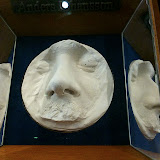
There is one more monument to describe, but it will have to wait until the proper context has been established. On then, to the thing I had been waiting for ever since Björn had described it to me: a visit to the Nose Museum. Yes, the Nasotek, an offshoot of the Esteemed Society, is a museum dedicated to that most upright member of our physiognomy, the nose. Hanging in its hallowed hall are the plaster likenesses of countless noses of various shapes and sizes, belonging to some of the most esteemed students, faculty, and starlets in Sweden. I offer my own nose for consideration:
And a rare honor: a nose captured with its nose. Here is Frederick, posing proudly with his nose.
Click on the photo below for a Picasa gallery of Nasotek shots. Notice that mirrors are set up in each nose box so that one may view the profile.
While the nose likenesses are the centerpiece and pride of the institution, there is much, much more going on. The Nasotek is a full-fledged academic institution, one that publishes a scholarly peer-reviewed journal. It has a Nasologiska fakultenten (Nosology faculty) that, naturally, awards the Doctor of Nosology. Frederick was most generous in gifting me a couple of the journals and two dissertations, one on the nose in heraldry, the other, the nose in music. This latter I shall take back to Berklee College of Music in Boston, put it in a jar with a cottonball soaked in ethyl acetate, laminate in a permanent position of posthumous postulatory perfection a la von Hagens’ “Body Worlds,” and enshrine next to the Stan Getz saxophone in the Berklee library.
The last feature of the Nasotek I shall describe is the final sculpture on the tour, found in the Nasotek itself. Now that you understand the depth of Nasologiska at Lund University, there is one more piece of the context necessary. The following “official” sculpture of the university lies outside in the leafy campus. It is a large block of stone, out of which a man struggles to emerge.
I was told that it might mean some kind of Struggle to escape calcifying Ignorance, or some such snobberdoodle. The Esteemed members of the Nasotek took it upon themselves not only to honor the original, but to honor, above all else, the Nose. In the following indoor (and scaled down) sculpture, you will notice that the block of stone is identical to the sculpture outside.
On the front side, we can see, not Man struggling to break through Ignorance, but the Nose. And only the Nose. Click on the photo to enlarge.
Because, it seems, that the man here has not quite made it as far through the stone as in the original, a certain fundamental part of him remains, revealed on the back side of the block.
I can only applaud the Nasotek for such an accomplishment, but the credit goes not only to them (and here, oh American University Administrations, take note!): I learned from Frederick that the importance of levity and humor within learning has actually been written into the mission of the University—that these statues are all sanctioned, nay, encouraged, that these and other nonsensical societies are a part of the institutional warp and weft, according to the University’s educational philosophy. Amazing.
The last leg of this tour took us to the Museum of Student Life, which had at one time been curated by Frederick. It is a storehouse of everything non-academic related to student life—the gags and photos, dramatic production scripts, notable clothing, props, and other ephemera, all pieces that probably would have been lost long ago if not for the museum. We saw various curiosities, including medals (which, in a way, mock the frequent bestowing of medals in Swedish culture), jerseys, statues, artwork, and other pieces, many of which came about because of the big festival/carnival that occurs every four years, full of pranks and carnivalesque nonsense. Of particular interest to us, however, was the material stored here authored by Axel Wallengren, otherwise known by his pseudonym, Falstaff, Fakir (the latter word being his “title”), one of the grandfathers of Swedish nonsense, and a Lund University student in the late nineteenth century. Frederick brought out a dusty box, and Björn and I had the privilege of looking through the original documents by the young nonsense artist. One notable document was titled “Lund Just Nu!” and is a parody of the Paris World’s Fair pamphlet. It has much nonsense in it, and Frederick used it as an example of how nonsense, even parodic nonsense, has a life well beyond parody (even though, it may be argued, all nonsense has some parodic tendencies). It is still funny today, even if we are not familiar with the original, parodied text about Paris—a sure sign of nonsense. Of course, Falstaff, Fakir’s text in some ways follows the model closely and has many inside jokes, but the humor and literary value hold because the parody goes beyond parody to nonsense.
Frederick agreed to read a particularly nonsensical passage from one of Falstaff, Fakir’s books, How to be a Scholar. In the first film, Frederick reads a parody of a schoolbook example of German phrases to be translated. You don’t need to know German to hear some of the nonsense and humor, but German speakers will find this especially good. The second film has the Swedish translation—which is completely nonsensical. (Note: If you look closely at these films, you should see in the upper right hand corner, a small statue that looks suspiciously like Frederick himself.)
Frederick introduced some other Lund University nonsensites, with their own pamphlets and ephemera, until we were up to our kippers in nonsense, but eventually we had to leave, took lunch at a beautiful old hotel nearby, famous for being a University institution, and took our leave back to Malmö. It’s hard to describe what an extraordinary tour this was, but I hope the length, at least, of this entry, begins to do so!
I was talking at a later point to a Finnish fellow, and when I mentioned Swedish nonsense he looked askance, but when I added some details about the University of Lund, he retreated, saying, “Oh, well of course in Lund such things may be so…”
Many thanks to Frederick (with whom, indeed, I have an affinity), and to Björn for setting this up.


 Greetings again, fellows nonsense nodules,




 Posts


